
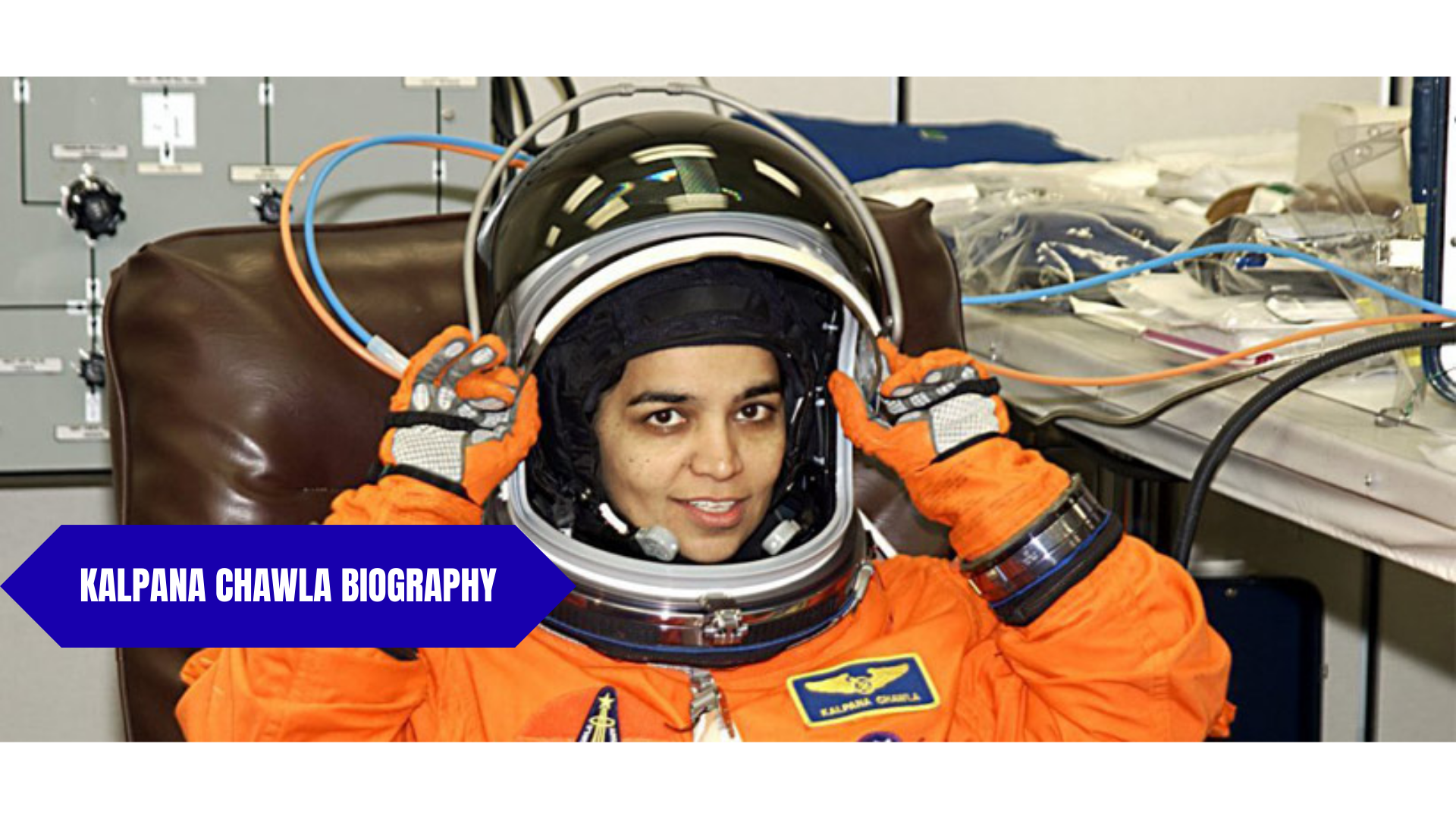
Kalpana Chawla Biography: Age, Husband, Education, Children, Death.
The story of Kalpana Chawla is one of courage, brilliance, and relentless determination. As the first woman of Indian origin to travel to space, she broke barriers and inspired millions across the globe. Her life journey from a small town in India to becoming a NASA astronaut symbolizes the power of dreams backed by hard work.
Kalpana Chawla’s biography is not just about space exploration; it is about ambition, education, resilience, and the pursuit of excellence. Even after her tragic death in the Space Shuttle Columbia disaster, her legacy continues to inspire generations of scientists, engineers, and dreamers worldwide.
In this comprehensive blog post, we explore her early life, education, NASA career, space missions, achievements, personal life, and enduring legacy.
Early Life
Kalpana Chawla was born on March 17, 1962, in Karnal, Haryana, India. Growing up in a traditional family, she showed early signs of curiosity and intelligence. From a young age, she was fascinated by airplanes and the night sky.
She often visited local flying clubs and watched aircraft take off and land. Unlike many girls of her time, she dreamed of becoming an aerospace engineer — a rare ambition in 1970s India.
Her early education took place in Karnal, where she excelled academically. Her teachers recognized her brilliance and encouraged her to pursue science and mathematics.
Educational Background
Kalpana Chawla’s academic journey played a crucial role in shaping her career.
Engineering in India
She earned a Bachelor of Engineering degree in Aeronautical Engineering from Punjab Engineering College in 1982. At a time when aerospace engineering was male-dominated, Kalpana stood out as one of the few women in her class.
Higher Studies in the United States
Determined to advance her knowledge, she moved to the United States for higher studies.
She obtained:
- Master of Science in Aerospace Engineering from University of Texas at Arlington
- Second Master’s degree and Ph.D. in Aerospace Engineering from University of Colorado Boulder
Her doctoral research focused on computational fluid dynamics — an advanced area in aerospace engineering.
Career at NASA
Kalpana Chawla’s professional journey took a significant turn when she joined NASA in 1988 as a researcher at Ames Research Center.
Becoming an Astronaut
In 1994, she was selected as an astronaut candidate. After completing rigorous training, she officially became a NASA astronaut in 1995.
Her selection was historic. She became:
- The first Indian-born woman astronaut
- The second person of Indian origin in space after Rakesh Sharma
First Space Mission: STS-87
Kalpana Chawla first flew in space aboard STS-87 in November 1997 on the Space Shuttle Columbia.
Key Highlights of STS-87:
- Spent over 15 days in space
- Conducted microgravity experiments
- Logged 372 hours in space
Although the mission had minor technical issues, it was a groundbreaking achievement for her and India.
Second Space Mission: STS-107
Her second and final mission was STS-107, launched on January 16, 2003.
The mission focused on:
- Scientific research
- Biological and physical experiments
- Microgravity studies
The crew conducted more than 80 experiments during their 16-day mission.
The Columbia Tragedy
On February 1, 2003, tragedy struck. During re-entry into Earth’s atmosphere, Space Shuttle Columbia disintegrated, killing all seven crew members.
The disaster was later attributed to damage caused during launch. The event deeply shocked the world and marked one of NASA’s darkest days.
Kalpana Chawla became a symbol of courage and sacrifice in the pursuit of science and exploration.
Personal Life
Kalpana Chawla married Jean-Pierre Harrison, a flight instructor and aviation author. Despite living in the United States, she maintained strong ties to India and proudly represented her heritage.
She was known for:
- Humility
- Discipline
- Passion for flying
- Deep commitment to science
She once said, “The path from dreams to success does exist.”
Achievements and Awards
Kalpana Chawla received several honors posthumously:
- Congressional Space Medal of Honor
- NASA Space Flight Medal
- NASA Distinguished Service Medal
Several institutions and landmarks have been named in her honor, including:
- Kalpana Chawla Government Medical College in Karnal
- Kalpana Chawla Memorial Scholarships
- An asteroid named after her
Her legacy extends beyond awards — she remains a global icon of women in STEM.
Legacy and Inspiration
Kalpana Chawla’s biography continues to inspire millions of young students, especially girls, to pursue careers in science, technology, engineering, and mathematics (STEM).
In India and worldwide:
- Schools celebrate her birth anniversary
- Scholarships encourage aerospace education
- Students study her life story
She proved that no dream is too big, regardless of background or gender.
FAQs
1. Who was Kalpana Chawla?
Kalpana Chawla was an Indian-American astronaut and aerospace engineer, and the first Indian woman to travel to space.
2. When was Kalpana Chawla born?
She was born on March 17, 1962, in Karnal, Haryana, India.
3. How did Kalpana Chawla die?
She died in the Space Shuttle Columbia disaster on February 1, 2003, during re-entry into Earth’s atmosphere.
4. What were Kalpana Chawla’s space missions?
Her missions were STS-87 (1997) and STS-107 (2003).
5. Why is Kalpana Chawla famous?
She is famous for being the first Indian-born woman astronaut and for her contributions to space research.
Conclusion
The biography of Kalpana Chawla is a powerful testament to determination, ambition, and courage. From her early days in Karnal to her groundbreaking achievements at NASA, she showed the world that dreams have no boundaries.
Though her life ended tragically, her impact remains eternal. She continues to inspire generations to look at the sky not just with wonder, but with purpose.
Kalpana Chawla’s legacy reminds us that the pursuit of knowledge is worth every challenge — even the ultimate sacrifice.